NATIONAL AND INTERNATIONAL VERSION WITH TRANSLATION

Wednesday, May 28, 2008

The Unlucky Saga of the Willie Dee


The Ill-Fated USS William D. Porter, DD-579
(from The Navy Times)

From November 1943 until her bizarre loss in June 1945, the American Destroyer William D. Porter was often met with the clever greeting, "Don't shoot, we're Republicans!" when she entered port or joined other naval ships. The significance of this expression was almost a cult secret of the United States Navy until the story resurfaced and received wide publicity after a ship's reunion in 1958.

More than half a century ago, the "Willie Dee, " as the William D. Porter was nicknamed, accidentally fired a live torpedo at the battleship Iowa during a practice exercise on November 14, 1943. As if this weren't bad enough, the Iowa was carrying President Franklin D. Roosevelt, Secretary of State Cordell Hull and all of the country's World War II military brass to the "big three" conferences in Cairo and Teheran. Roosevelt was to meet with Stalin of the Soviet Union and Churchill of Great Britain, and had the W.D. Porter's successfully launched torpedo struck the Iowa at the aiming point, the last 50 years of history of world history might have been quite different. Fortunately, the W.D. Porter's warning allowed the Iowa to evade the speeding torpedo and historic events carried on, as we know them.

The USS William D. Porter (DD-579) was one of hundreds of big war-built assembly line destroyers. Although smaller than current destroyers, they were powerful and menacing in their day. They mounted a main battery of five dual-purpose 5-inch, .38-caliber guns, and an assortment of 20 mm and 40 mm AAA guns, but their main armament consisted of 10 fast-running and accurate torpedoes that carried 500-pound warheads.

The W.D. Porter was placed in command on July 6, 1943 under the command of LCDR Wilfred A. Walter, a man on the Navy's career fast track. In the months before she was detailed to accompany the Iowa across the Atlantic in November 1943, the W.D. Porter's crew members learned their trades, but not without experiencing certain mishaps that set the stage for the "big goof." The mishaps began in earnest with the mysterious order to escort the pride of the fleet, the big new battleship Iowa to North Africa. The night before it left Norfolk, Virginia, the W.D. Porter successfully demolished a nearby sister ship when she backed down along the other ship's side and, with her anchor, tore down railings, a life raft, the captain's gig and various formerly valuable pieces of equipment. The Willie Dee suffered merely a slightly scratched anchor, but her career of mayhem and destruction had begun.

The next event occurred just 24 hours later. The four-ship convoy, consisting of the Iowa and her secret passengers, the W.D. Porter and two other destroyers, was under strict instruction to maintain complete silence as they were going through a known U-boat feeding ground where speed and silence were the best defenses. Suddenly, a tremendous explosion rocked the convoy, and all of the ships commenced anti-submarine maneuvers. The maneuvers continued until the W.D. Porter sheepishly admitted that one of her depth charges had fallen off of the stern and detonated in the rough sea. The safety had not been set as instructed; Captain Walter's fast track career was fast becoming sidetracked.

Shortly thereafter, a freak wave inundated the W.D. Porter, stripping everything that wasn't lashed down and washing a man overboard who was never found. Next, the engine room lost power in one of its boilers. And, during all, the captain had to make reports almost hourly to the Iowa on the Willie Dee's difficulties. At this point, it would have been merciful for the force commander to have detached the hard luck ship and sent her back to Norfolk. But that didn't happen.

The morning of November 14, 1943, dawned with a moderate sea and pleasant weather. The Iowa and her escorts were just east of Bermuda when the president and his guests wanted to see how the big ship could defend herself against an air attack, so the Iowa launched a number of weather balloons to use as anti-aircraft targets. Seeing more than 100 guns shooting at the balloons was exciting, and the president was duly proud of his Navy. Just as proud was Chief of Naval Operations Admiral Ernest J King, large in size and by demeanor a true monarch of the seas. Disagreeing with him meant the end of a naval career. Up to this time, no one knew what firing a torpedo at him would mean!

Over on the Willie Dee, Captain Walter watched the fireworks display with admiration and envy. Thinking about career redemption and breaking the hard luck spell, the captain sent his impatient crew to battle stations, and they began to shoot down the balloons that, missed by the Iowa, had drifted into the W.D. Porter's vicinity.Down on the torpedo mounts, the W.D. Porter's crew watched and waited--and prepared to take practice shots at the big battleship, which, even at 6,000 yards, seemed to blot out the horizon. Torpedomen Lawton Dawson and Tony Fazio were among those responsible for the torpedoes and for ensuring that the primers (small explosive charges) were installed during actual combat and removed during practice. Dawson, unfortunately, forgot to remove the primer from torpedo tube number three.

Up on the bridge, a new torpedo officer ordered the simulated firing and commanded, "Fire one." "Fire two," and finally, "Fire three." There was no "Fire four." The sequence was interrupted by a whoooossshhh - the unmistakable sound made by a successfully armed and launched torpedo. LT H. Seward Lewis, who witnessed the entire event, later described the next few minutes as what hell would look like if it ever broke loose. Just after he saw the torpedo hit the water on its way to the Iowa, where some of the most prominent figures in world history stood, he innocently asked the captain, "Did you give permission to fire a torpedo?" Captain Walter uttered something akin to, "Hell, no. I, I, iii, aaa, iiiii --- what?!" Not exactly in keeping with some other famous naval quotes, like John Paul Jones', "I have not yet begun to fight," or even Civil war era RADM David Glasgow Farragut's, "Damn the torpedoes - full speed ahead!" although the latter would have been appropriate.

The next five minutes aboard the Willie Dee were pandemonium. Everyone raced around shouting conflicting instructions and attempting to warn the Iowa of imminent danger. First, a flashing light attempted a warning about the torpedo but indicated the wrong direction. Next, the W.D. Porter signaled that she was going in reverse at full speed. Despite the strictly enforced radio silence, it was finally decided to notify the Iowa. The radio operator on the destroyer yelled, "Lion [code word for the Iowa], lion, come right!" The Iowa operator, more concerned about improper radio procedure, requested that the offending station identify itself first. Finally, the message was received, and the Iowa began turning to avoid the speeding torpedo.

Meantime, on the Iowa's bridge, word of the torpedo firing had reached President Roosevelt. He only wanted to see the torpedo and asked that his wheelchair be moved to the railing. His loyal secret Service bodyguard immediately drew his pistol as if to shoot the torpedo! The Iowa began evasive maneuvers, yet trained all guns on the William D. Porter. There was now some thought that the W D. Porter was part of an assassination plot. Within moments of the warning, a thunderous explosion occurred behind the Iowa. The torpedo had been detonated by the wash kicked up by the battleship's increased speed. The crisis was over, and so were some careers. Captain Walter's final utterance to the Iowa was in response to a question about the origin of the torpedo. His answer was a weak, "We did it."

Shortly thereafter, the new state-of-the-art destroyer, her ambitious captain and seemingly fumbling crew were placed under arrest and sent to Bermuda for trial. It was the first time in the history of the United States Navy that an entire ship and her company had been arrested. The William D. Porter was surrounded by Marines when it docked in Bermuda and was held there for several days as the closed-session inquiry attempted to find out what had happened. The outcome was delayed for a couple of days until Torpedoman Dawson finally confessed to having inadvertently left the primer in the torpedo tube, which caused the launch. Just after the torpedo left its tube, Dawson had thrown the primer over the side to conceal his mistake. The truth was eventually pried out of him, and the inquiry drew to a close. The whole incident was chalked up to an incredible set of circumstances and placed under a cloak of secrecy.That's not to say that the Navy took no action. Captain Walter and several former William D. Porter officers and sailors eventually found themselves in obscure shore assignments and Dawson was sentenced to 14 years of hard labor. President Roosevelt intervened, however, and asked that no punishment be meted out as the near disaster had been an accident.

The destroyer next found herself in the upper Aleutians on patrol. It was probably thought that this was as safe a place as any for the destroyer and those around her. But before being reassigned to another area in the Pacific, she accidentally, but of course, successfully, lobbed a 5-inch shell into the front yard of the American base commandant.

When the William D. Porter later joined other ships off Okinawa, the destroyer did distinguish herself by shooting down a variety of Japanese aircraft and, reportedly, three American planes! She was generally greeted by, "Don't shoot; we're Republicans," and the crew of the Willie Dee had become used to the ribbing. However, the crew members of a sister ship, the USS Luce, were not so polite in their greetings after the W.D. Porter accidentally riddled her side and superstructure with gunfire. On June 10, 1945, the hard luck ship met her end. A Japanese "Val" bomber, constructed almost entirely of wood and canvas, slipped through the defenses. As it had very little metal surface, the bomber was not unlike our present-day stealth planes. It did not register on radar. The bomber, a fully loaded kamikaze, headed for the ship near the W.D. Porter but, at the last moment, veered away and crashed alongside the unlucky destroyer. There was a sigh of relief as the plane sank out of sight without exploding. Unfortunately, it then blew up underneath the destroyer and opened up the ship's hull in the worse possible location. Three hours later, the last man, the captain, jumped to the safety of a rescue vessel, leaving the ship that almost changed the face of the world and national politics to slip stern first into 2,400 feet of water.

Miraculously, not a single soul was lost in the sinking. It was almost as if the ship that had been so unlucky chose to let her crew live. The saga of the USS William D. Porter was over.

USS William D. Porter was named in honor of Commodore William D. Porter (1808-1864), who played an important role in Civil War operations on the Western Rivers during 1861-62.

Walter

Tuesday, May 27, 2008

So You Think You Know Everything?

Rubber bands last longer when refrigerated.

Peanuts are one of the ingredients of dynamite.

There are 293 ways to make change for a dollar.

The average person's left hand does 56% of the typing.

A shark is the only fish that can blink with both eyes.

There are more chickens than people in the world.

Two-thirds of the world's eggplant is grown in New Jersey.

The longest one-syllable word in the English language is screeched.

On a Canadian two dollar bill, the flag flying over the Parliament building is an American flag.

All of the clocks in the movie "Pulp Fiction" are stuck on 4:20.

No word in the English language rhymes with month, orange, silver, or purple.

"Dreamt" is the only English word that ends in the letters "mt".

All 50 states are listed across the top of the Lincoln Memorial on the back of the $5 bill.

Almonds are a member of the peach family.

Winston Churchill was born in a ladies' room during a dance.

Maine is the only state whose name is just one syllable.

There are only four words in the English language which end in "dous": tremendous, horrendous, stupendous,

Los Angeles' full name is "El Pueblo de Nuestra Senora la Reina de los Angeles de Porciuncula"

A cat has 32 muscles in each ear.

An ostrich's eye is bigger than its brain.

Tigers have striped skin, not just striped fur.

In most advertisements, the time displayed on a watch is 10:10

Al Capone's business card said he was a used furniture dealer.

The characters Bert and Ernie on Sesame Street were named after Bert the cop and Ernie the taxi driver in Frank Capra's "It's a Wonderful Life."

A dragonfly has a life span of 24 hours.

A goldfish has a memory span of three seconds.

A dime has 118 ridges around the edge.

It's impossible to sneeze with your eyes open.

The giant squid has the largest eyes in the world.

In England, the Speaker of the House is not allowed to speak.

The microwave was invented after a researcher walked by a radar tube and a chocolate bar melted in his pocket.

Mr. Rogers was an ordained minister.

The average person falls asleep in seven minutes.

There are 336 dimples on a regulation golf ball.

"Stewardesses" is the longest word that is typed with only the left hand.

Just thought you'd like to know.....

Walter

Chicago's O'Hare Airport and the WWII connection

During the course of World War II, many people gained fame in one way or another. One of these was Butch O'Hare, a fighter pilot assigned to an aircraft carrier in the Pacific. On one occasion his entire squadron was assigned to fly a particular mission. After O'Hare was airborne, he looked at his fuel gauge and realized that someone had forgotten to top off his fuel tank. Because of this, he would not have enough fuel to complete his mission and get back to his ship. His flight leader told him to leave formation and return.


As he was returning to the mothership, O'Hare could see a squadron of Japanese Zeroes heading toward the fleet to attack. With all the fighter planes gone, the fleet was almost defenseless, his was the only opportunity to distract and divert them. Single-handedly, he dove into the formation of Japanese planes and attacked them. Butch dove at them and shot until all his ammunition was gone, then he would dive and try to clip off a wing or tail or anything that would make the enemy planes unfit to fly. He did anything he could to keep them from reaching the American ships. Finally, the Japanese squadron took off in another direction, and Butch O'Hare and his fighter, both badly shot up, limped back to the carrier. The American fighter planes were rigged with cameras, so that as they flew and fought, pictures were taken so pilots could learn more about the terrain, enemy maneuvers, etc. So, even though O'Hare told his story, it was not until the film from the camera on his plane was developed, that they realized the extent he really went to, to protect his fleet. He was recognized as a hero and given one of the nation's highest military honors.

O'Hare Airport in Chicago was later named after him.

During the gangster era, in Chicago, there was a man called Easy Eddie. He was working for a man you've all heard about: Al Capone. Al Capone wasn't famous for anything heroic, but he was notorious for the murders and crimes he'd committed. Easy Eddie was Al Capone's lawyer, and a very good one. In fact, because of his skill, he was able to keep Al Capone out of jail. To show his appreciation, Al Capone paid him very well. He not only earned big money, he would get extra things, like a residence that filled an entire Chicago city block. The house was fenced, and he had live-in help and all of the conveniences of the day.

Easy Eddie had a son. He loved his son and gave him all the best things while he was growing up: clothes, cars, and a good education. And, because he loved his son he tried to teach him right from wrong. But one thing he couldn't give his son was a good name, nor could he be a good example. Easy Eddie decided that this was much more important than all the riches he had given his son. So, he went to the authorities in order to rectify the wrong he had done. It meant he must testify against Al Capone, and he knew that Al Capone would do his best to have him killed. But, he wanted most of all to try to be an example and to do the best he could to give back to his son a good name. So, he testified. Within the year, he was shot and killed on a lonely street in Chicago.

Do these stories seem unrelated? Butch O'Hare was Easy Eddie's son.

Walter

The Physics of Traffic Jams

For all my friends and family who say what I do as a physicist has no practical influence or meaning in their lives, guess again, my non-Reebok wearing, non-slide rule-carrying bipeds.

Phases and phase transitions

Try to tell somebody that you are studying the transitions of matter from one phase to another and they will immediately think of the way water turns into ice. Yes, this is a classical example, something that we have learned when we were little kids: ice and snow melt in your hands and turn into water and when water gets frozen, it becomes ice. Actually there are still a lot of questions about these processes that are not well understood, such as snowflakes patterns, the dependence of the freezing temperature on various factors, etc. However, the physics of phase transitions would be very boring if it was only limited to what happens to water.

Fortunately, there are many other substances in the world. Some are solids, some are liquids and some are gases, some are magnetic and some are not, some can easily conduct electrical current and some are insulating. One of the most interesting kind of phenomena is when a certain material suddenly qualitatively changes its properties when we only slightly vary the external conditions, such as temperature. Just like water turns into ice at 0o C (32o F), iron can become magnetic and mercury superconducting at their own critical temperatures.

However, the concept of phase transitions goes even beyond that. Every complex system has some unique properties that specify the current phase. And when the external conditions change smoothly, this system can suddenly begin to develop qualitatively new features. In fact, some of these complex systems have nothing to do with physics! One of the excellent examples is something that most of us are familiar with in our everyday lives.

Traffic

Imagine a highway with lots of rapidly moving cars. What is the probability that a given car at given instant has exactly the speed at 51.918654 miles per hour? Of course, zero. It is hard even to measure the velocity with such precision. What is the probability that two cars are moving at exactly the same speed? Also zero, unless one car is towing another. In real life you can not make two numbers precisely equal and when we say "their speeds are equal," we mean that they are approximately the same, that is, they will become equal if you round off each number a bit.

But there is a special condition on the road when some of the cars have the speeds known exactly, with arbitrary precision. This special condition is also characterized by a remarkable property that some of the cars have precisely the same speed! Because this speed is zero. The cars are not moving at all! We are all familiar with such a state of highway traffic: it is called traffic jam.

Traffic jam does not mean that each car has permanently stopped. From the point of view of each individual driver, he moves for a while, then stops, then moves again, then stops again, and so on. From the point of view of the helicopter hovering over the highway, some of the cars are stopped at any given moment, and not just one car or two -- there is some nearly constant macroscopic fraction of all the cars on the highway (say, 10% or 30%), whose speed is zero.

This fraction is clearly a new measure characterizing the traffic flow. In the "normal" state of the highway this measure is zero. All the cars have different speeds (the system is disordered) and none have stopped (if one or two cars have stopped for some reason, this does not really count, because we are interested in macroscopic phenomena that affect all cars).

In the case of the traffic jam, this fraction is nonzero and each car on the highway will stop at some moment. Ironically, it is conventional to call such a state as ordered one, because the state when some cars are not moving is substantially less random than when all cars move with different velocities. This description agrees with our experience that traffic jam is a state of the flow on the highway that is qualitatively different from free traffic. Can physics tell us some nontrivial facts about it?

Order and symmetry

In the physics of phase transitions, ordered phases are usually characterized by an order parameter, a quantity that is zero in the normal state and takes a nonzero value in the ordered one. It appears that the fraction of the stopped cars at the given moment has this property, indeed. However, it actually does not give a complete description. Namely, it does not reflect the fact that the formation of traffic jams is associated with breaking of a certain symmetry.

What is a symmetry? The symmetry is a transformation of the system that leaves it invariant. The most obvious symmetries appear in elementary geometry. After you rotate a circle about its center by any angle, you can superpose it with the original circle. If you reflect a square about any line of symmetry (there are four of them and they all pass through the center), it will match the original square.

The free traffic has a symmetry, too! It is nearly impossible to keep the speed of the car perfectly constant, therefore, each car either accelerates or slows down, at least slightly. If you videotape the highway and then replay the tape in the opposite direction (that is, effectively, reverse time), the accelerating cars will replace the decelerating ones and vice versa. However, even if you do not reverse time, such a replacement does not change the flow substantially. As long as each driver has a choice -- either to accelerate or to slow down -- he will help the flow to be as close to optimal one as possible, from any initial state of the highway -- as long as the traffic is free. In mathematics, such symmetry is denoted as Z 2.

The situation qualitatively changes when a driver absolutely can not accelerate and must slow down (or stay still, if he has already stopped). This may happen due to an accident ahead, due to the local jam, due to traffic signals or even because of another irresponsible driver. Of course, in practice, this means that the driver no longer controls the speed with the pressure on the gas pedal and moves his foot over the brakes pedal. The fact that the driver no longer has a choice, that it is impossible to cause him to accelerate even a tiny bit, means that the symmetry is broken.

Consequently, the state of the traffic jam has an order parameter that reflects the breaking of this symmetry. This order parameter is the number of the cars that can not accelerate (divided by the total number of the cars). Although the situations in which a driver has no choice but to slam on the breaks may occur spontaneously, the important thing is the average picture. If the dangerous situation has disappeared a few seconds later, then it has been merely a fluctuation. However, if the relative number of the cars that are unable to accelerate remains constant -- one car this moment, another car next moment -- then the order parameter is nonzero and the highway is in a separate, ordered state.

Jam

The fact that we have identified the traffic jam as an ordered phase, a special state of the traffic flow with broken symmetry and an order parameter, is very important, because now we can proceed to the further analysis of its unique properties and of what happens when the jam just begins.

First of all, it is quite obvious that the transition of the flow into the jammed state can be triggered by such factors as the density of cars on the highway (as viewed from the helicopter) or the condition of the road, or even the slow reaction of the drivers. For low density of cars, the traffic is free. The more cars on highway, the more cars pass through it. We can define traffic current as the number of cars that passes by a certain location on the highway per second. This will be our measure of the traffic flow. Then for free traffic, when the average speed of the cars does not substantially depend on their number, this current is simply proportional to the density of cars.

What happens as the density increases? The studies show that at some moment the current saturates. The density of cars increases, but the traffic current does not. And then the current suddenly drops. That is right, there is almost discontinuous drop in current as the density increases slightly above the critical value! After that the dependence of the traffic current on the density of cars becomes reverse: as the density increases, the overall flow decreases.

This is, of course, due to the jam. Normally, each driver is acting in a way to keep traffic smooth. If somebody slows down a bit, others quickly adjust their speeds, some people change lanes, and as a result, the flow returns to the initial state. This means that when the traffic flow is "optimal," small fluctuations in the speeds of individual cars will rapidly decay.

However, the jammed cars can not adjust their speeds, because they can not accelerate. As a result, the fluctuations in the velocities never decay. Instead, they propagate as waves (collective modes). What the drivers typically see is that the cars ahead start to move, then accelerate, then slow down, and then stop. Each driver knows that he will follow precisely the same pattern when the wave reaches him. The fact that traffic can not restore its optimal state has catastrophic consequences for the flow, which leads to the abrupt decrease of the current mentioned above.

Maybe it is possible to drive without fluctuations? The answer is "No." As I have already mentioned, you can not maintain a perfectly constant speed even if you are alone on the highway. As a result, some fluctuations occur all the time.

People and their will

At this moment somebody could interrupt me: "Wait a minute! People do not want to sit in traffic jams. People are actually doing their best to keep the flow smooth!"

That is exactly what happens... but it can still be described perfectly well in the presented picture!

Indeed, people fight the traffic jams as much as they can. When the density of cars approaches critical, the drivers begin to coordinate their efforts, which leads to a synchronized flow. The synchronized flow is still a free flow (that is, without jams), however, the average speed of the cars begins to decrease with the density so that the overall traffic current is nearly constant. Although all cars, strictly speaking, move with different speeds, their velocities become very close to each other. For example, the drivers try not to speed up when a gap opens in front of them, avoid changing lanes, and so on.

The net result of these coordinated efforts is that some of the fluctuations simply disappear, because people do not let them propagate. In order for this to happen, these fluctuations have to be characterized by a time scale that is less than human reaction time, that is, they have to be rather slow. However, near the point of the transition from free traffic into the traffic jam, the most "dangerous" fluctuations are precisely the slow ones. Essentially, the transition can not take place without them at all! Therefore, when the density of cars is near critical one, the suppression of slow fluctuations makes the transition into the jammed state impossible and the traffic remains synchronized.

As the density of cars continues to increase, the time scale for the "dangerous" fluctuations decreases. At some point people can no longer react fast enough to suppress them, the local jams emerge, which rapidly grow, and soon the entire highway slides into the jammed state. At the moment of the transition, the order parameter, which was introduced above, jumps from zero to a finite value, which is a signature of so called first-order phase transitions in physics.

I would like to emphasize that in the state of the synchronized flow, the exact density of cars, at which the jam develops, substantially depends on the drivers. The better is their reaction and the higher is their culture, the longer they are able to postpone the transition. A single irresponsible or inexperienced driver can ruin the efforts of the rest and can create the traffic jam.

Summary

Thus, what happens with traffic when the number of cars on the highway increases?

Initially, the traffic is free and the number of cars on the highway does not substantially affect their average speed. Therefore the flow linearly increases with the density of cars. The drivers accelerate or slow down a bit in order to keep the flow close to the optimal one.

Then people begin to notice more and more dangerous fluctuations in the distance and the velocities of the cars ahead and around them. Thanks to their appropriate reaction, they can suppress the slow fluctuations, but the fast fluctuations survive and propagate as density waves in the opposite direction of the flow of traffic. The people begin to drive more slowly and to adjust their speeds close to each other, leading to a synchronized flow. The entire highway traffic balances at the edge of falling into the traffic jam.

However, as the density of cars further increases, the fast fluctuations begin to grow, the synchronized flow breaks down and the flow becomes jammed. Some of the cars can not accelerate and stop, while the rest can temporarily enjoy "free traffic." In fact, every car spends some time in the jam and at any given moment the number of stopped cars is macroscopically large and is almost constant. The fraction of the cars that are temporarily unable to accelerate is the order parameter, which is a quantitative measure of the traffic jam. The stopped cars often group together, in which case such local jams appear to propagate slowly at nearly constant speed, corresponding to the velocity of the collective modes.

Once the traffic is in the jammed state, increasing the density of cars will cause the order to enhance, too. There will be fewer and fewer cars able to move fast, which will decrease the traffic flow.

This is an example of how the modern vision of the physics of phase transitions allows one to understand conceptually how the traffic jams occur and what characterizes them. Of course, this post is only an overview, since the research on the traffic flow has been active for the past 20 years.

If you sit in a some gridlock this summer, you might come to the end of the line of cars and realize, hey, there's nothing there. No accident, no police on the shoulder, just a bunch of cars that aren't getting where they want to go. Over at the Universities of Exeter (in England), Bristol and Budapest, mathematicians now think they've figured out why this happens (and wastes lots of gasoline in the process).

The short answer: braking and full roads. When there are between 10 and 15 vehicles on a one-kilometer stretch of highway and the front one hits the brakes, a "backward travelling wave" is created that can sometimes lead to traffic jams. As Dr. Gábor Orosz of the University of Exeter's School of Engineering, Computing and Mathematics, said in a statement: "As many of us prepare to travel long distances to see family and friends over Christmas, we're likely to experience the frustration of getting stuck in a traffic jam that seems to have no cause. Our model shows that overreaction of a single driver can have enormous impact on the rest of the traffic, leading to massive delays." He continued: "When you tap your brake, the traffic may come to a full stand-still several miles behind you. It really matters how hard you brake - a slight braking from a driver who has identified a problem early will allow the traffic flow to remain smooth. Heavier braking, usually caused by a driver reacting late to a problem, can affect traffic flow for many miles."

This seems like a problem with no solution. Not braking could lead to accidents, which certainly don't make the highways easier to travel on. And removing cars from the road would be appreciated by many, until public transportation becomes a better option, it ain't gonna happen. So, if you get stuck on the way to or from grandmother's house this year, at least you now kind of know why.

The DOT may not do much (they never look like they're DOING anything), but at least I can say I'm having a productive day and put it in terms everyone can relate to, if not completely understand. Don't you just love math and science now?

Walter

The Neurochemistry of Forgiving and Forgetting

Brain trust. The hormone oxytocin may spur us to trust others even when they betray us by suppressing activity in the dorsal striatum (top, red regions) and amygdala (bottom).
Credit: Thomas Baumgartner/University of Zürich


Trust forms the foundation of healthy relationships, and now scientists are zeroing in on how the feeling is triggered by chemicals in the brain. A new study shows that the hormone oxytocin may spur us to trust others even after they have betrayed us by suppressing a region of the brain that signals fear. The findings could lead to a better understanding of social phobias and related disorders.
Previous research has shown that oxytocin increases our feelings of trust and plays an important role in bonding with others. But the areas of the brain it acts on to produce that effect have remained a mystery. To get a better handle on how the hormone affects our noggins, Thomas Baumgartner, a neuroscientist at the University of Zürich, Switzerland, and colleagues monitored the brain activity of 49 men while they engaged in a game involving trust and betrayal.

In the game, the men were given money that they could share with another person who might increase the funds through investments and split the profits or betray them and keep all the money. When volunteers got a whiff of oxytocin via a nasal spray, their trust did not diminish even when the second player kept the money to himself half the time. In contrast, men who received a placebo spray reduced the amount of money they forked over.

Functional magnetic resonance imaging of the brains of the men who received oxytocin showed a drop in activity in a region called the amygdala, which plays a key role in triggering fear. The dorsal striatum, a region involved in learning from mistakes, also showed diminished activity. However, oxytocin did not reduce activity in these brain regions when the men played a similar game with a computer, confirming that the interaction with another person--and not just the hormone--was required to spur the changes, the researchers report in the 22 May issue of Neuron.

The findings suggest that oxytocin helps us maintain relationships by decreasing our fear of betrayal and other potential negative consequences of interacting with others, says Mauricio Delgado, a cognitive neuroscientist at Rutgers University in Newark, New Jersey. "Humans are typically averse towards social risks, so a little bit of oxytocin may facilitate carrying on relationships with others," he says.

The findings raise the possibility that social phobia is caused in part by a defect in how oxytocin normally regulates brain activity, Baumgartner says. Andreas Meyer-Lindenberg, a neuroscientist at the Central Institute of Mental Health in Mannheim, Germany, suggests that oxytocin signaling could also be disrupted in other disorders in which lack of trust or social attachment is a prominent problem, such as autism and schizophrenia.

Walter

Integrity: Thoughts on Right Thinking

I was once told by my grandfather, a judge, that "integrity is doing the right thing when no one is looking." I know many stories and examples of integrity and just as many that illustrate situations where integrity was severely lacking. I was also once told that if you tell of your integrity and good deeds, then they mean nothing and no longer hold value. At the risk of that, I would like to illustrate a point - something I did and had no thought about until later. This is not to pat myself on the back; it is to give an example that all of us in the smallest of ways can develop integrity. Afterall, we are all a work in progress, especially me.

It was Saturday evening, I was running around getting everything taken care of and picked up/completed for the Memorial Day get together that was happening on Sunday (rather than Monday) at the parent's home of my significant other. I grabbed what I needed for the event that I didn't get several days prior, as well as groceries, into the shopping cart. In my haste, I had forgotten to tell the cashier at the local Publix about the big pack of Cokes that I had placed on the bottom rack of the cart; I didn't realize I hadn't paid for it until I had gotten to my car to unload everything.

I injured my leg several weeks ago in a freak accident in the lab at work, so my leg was really killing me by the time I had arrived at my car with my groceries. I looked at the big package of Coca-Cola and it seemed to look back at me waiting to see what I would do. I didn't have to think about it. I grabbed the Coke pack and headed back inside to tell the cashier what had happened. I think he thought I was joking - he looked at me a little shocked.

Sure it was only less than $3.00 for the pack, but the decision of the right thing to do required no thought, no second guessing, no conflicts. I owe my actions to my relationship with Christ and how my parents raised me. It is to their credit I acted correctly, not mine.

They are like clouds and wind that bring no rain

If you lived in an arid land, imagine your disappointment when the dark clouds you saw and howling wind your felt brought no rain. Is the disappointment no less when the people in our lives fail to live up to their promises? That's why it is written in the Book of Proverbs, "People who promise things they never give are like clouds and wind that bring no rain." (Prov. 25:14) This lesson in the Book of Proverbs deals with INTEGRITY. When what people think, say, promise, and do all coincide, they have integrity. They have unshakable character. They have our trust and respect. They also have a good reputation because they are reliable and responsible.

A building without integrity may receive structural damage, or even collapse, in a storm. Similarly, people without integrity are blown about by the winds of misfortune and destroyed by catastrophes, for they lack the firmness, solidity, and strength of character to weather any storm. Dr. William Menninger (1899 ~ 1966) called integrity one of the six essential qualities that are the key to success. (The other five are sincerity, humility, courtesy, wisdom, and charity.)

Integrity is about principle centered living. It is about doing what is right rather than what is expedient. We have integrity when we are the good person we appear to be. For this reason Socrates (469 ~ 399 BC) taught, "The greatest way to live with honor in this world is to be what we pretend to be." And Socrates was an exemplary example of integrity, for he placed his life at risk by refusing to carry out orders that were immoral. Finally, when he was accused of "impiety," he was sentenced to die; however, as was the custom at the time, he was given a chance to make a counterproposal. He suggested his death sentence be replaced with a fine of thirty mina (3,000 drachmas), but insisted he lived an honorable life and was an excellent role model. His 'lack of repentance' infuriated the court, which then condemned him to death. While waiting in prison, before given the poisonous hemlock to drink, friends visited him and planned an escape. But Socrates refused to flee, explaining that although the charges against him were unjust and bogus, they were made by a legitimate court and must therefore be obeyed.

To remove any doubt of what it means to live with integrity, let me cite two more examples. After the U.S. Civil War, General Robert E. Lee (1807 ~ 1870) was offered $10,000 a year to become President, in name only, of an insurance company. He declined the offer with these words, "Excuse me, sir; I cannot consent to receive pay for services I do not render."

Here's the second example I promised. Bobby (Robert Tyre) Jones (1902 ~ 1971) was a lawyer and amateur golfer. He was also the first to achieve the Grand Slam - winning in a single year the four major tournaments.

From 1923 through 1930 he won 13 championships in those four annual tournaments. His record was unmatched until 1973, when it was finally broken by Jack Nicklaus. The above attests to his athletic skills; now let's move on to a testament of his integrity. In a national championship, he drove his ball into the woods, and accidentally nudged it. Although no one saw him move the ball, he penalized himself one stroke, which caused him to lose the game by that margin. When praised for his integrity, he said, "You might as well praise a man for not robbing a bank."

Now that we have some examples of integrity in action, it's time for an example of what integrity is not. Lance has much to like about him. He's energetic, curious about life, and an avid reader. But others think he is obnoxious. You see, although he's interested in self-improvement, his focus is on OTHERS improving themselves. He loves to be 'brutally honest', with the emphasis on brutality and the neglect of honesty. He doesn't hesitate to tell others any of the following: "You're too fat and need to lose weight!" "I have never heard of such a stupid idea; you're completely wrong!" "Sick? You're not sick; it's all in your mind!"

When asked why he is so hurtful to others, Lance simply replies, "I can't help it. I'm honest and say whatever is on my mind. If others can't handle the truth, it's their problem, not mine." Integrity is noble, Lance's behaviour is not. Integrity springs from the desire to do what is RIGHT. Lance's conduct is an attempt to prop up his falling self-esteem. Unable to think of something good to say about himself, he points out the 'weaknesses' of others with the hope it proves he is superior. Integrity inspires others; Lance's actions demean others. Integrity is about honesty. Lance is not honest because he lies when he says, "I can't help it." Of course he can help it, but he chooses not to change because bolstering his ego is more important to him than freeing others from the pain he inflicts.

When we commit to integrity we empower and free ourselves. Unencumbered by the fear of ridicule and rejection by others, we do what we believe is right. The rewards for doing so are many and include a growth in self-confidence and courage. The exhilaration of doing the right thing is like experiencing the joy of reaching the other shore by victoriously swimming against the current. Don't be afraid to be different. How can we be ourselves unless we are unlike others?

Tasks become duties to those who embrace integrity. At the workplace, they don't 'put in time,' but cheerfully carry out their responsibilities; they don't engage in destructive gossip, but build confidence, teamwork, and morale; they don't abuse their privileges, but respect their employer's property and reputation.

Integrity is the cornerstone of every marriage. The honesty and respect both partners bring to the relationship builds trust, confidence, and love. And when children arrive, they act as role models, displaying how their thoughts, words, and actions remain consistent. And because they keep their promises, their children lack the resentment found in many other homes.

Integrity should also be the centerpiece in our circle of friends. For example, consider the words of St. Francis of Assisi (1181 ~ 1226), "Blessed is the servant who loves his brother as much when he is sick and useless as when he is well and can be of service to him. And blessed is he who loves his brother as well when he is afar off as when he is by his side, and who would say nothing behind his back he might not, in love, say before his face."

"The Paradoxical Commandments" that I am ending this article with were written by Kent Keith in 1968, when he was 19 and a sophomore at Harvard. They were part of his first booklet for high school student leaders. Although just 30,000 copies of the student leadership booklet were published, his "Paradoxical Commandments" spread widely, endearing themselves to many. In fact, they were found hanging on the wall of Mother Teresa's room. There is no better way to lead a life of integrity than by following Kent Keith's Paradoxical Commandments:


The Paradoxical Commandments
by Dr. Kent M. Keith

People are illogical, unreasonable, and self-centered.
Love them anyway.

If you do good, people will accuse you of selfish ulterior motives.
Do good anyway.

If you are successful, you win false friends and true enemies.
Succeed anyway.

The good you do today will be forgotten tomorrow.
Do good anyway.

Honesty and frankness make you vulnerable.
Be honest and frank anyway.

The biggest men and women with the biggest ideas can be shot down by the smallest men and women with the smallest minds.
Think big anyway.

People favor underdogs but follow only top dogs.
Fight for a few underdogs anyway.

What you spend years building may be destroyed overnight.
Build anyway.

People really need help but may attack you if you do help them.
Help people anyway.

Give the world the best you have and you'll get kicked in the teeth.
Give the world the best you have anyway.

http://www.paradoxicalcommandments.com

Walter

Monday, May 26, 2008

Memorial Day 2008

Memorial Day is a United States federal holiday that is observed on the last Monday of May. It was formerly known as Decoration Day. This holiday commemorates U.S. men and women who died in military service for our country. It began first to honor Union soldiers who died during the American Civil War. After World War I, it expanded to include those who died in any war or military action. We sometimes forget the reason for this holiday. No, it is not to give us another three-day weekend. Nor is it just simply the start of the season in which wearing white is acceptable. It is a day to remember those who have made the ultimate sacrifice - giving their lives - so that we might live free.

Walter

Thursday, May 22, 2008

Strange Goings-on at Zaxby's

Zaxby's is a franchised chain of fast casual restaurants that operates in the southeastern United States. In this chain there are about 401 locations. The first Zaxby's was opened in Statesboro, Georgia, near the Georgia Southern University campus, by Zach McLeroy and Tony Townley. Its menu is built around buffalo wings and chicken fingers, including them on platters, in sandwiches, and on salads (called Zalads on their menu). Zaxby's is also well known for its wide variety of unique dipping sauces such as the original Zax Sauce. Zaxby's serves soft drinks in the Coca-Cola family. The dining rooms at Zaxby's restaurants are decorated with assorted whimsical objects and posters, which often vary in theme by location and which occasionally are regionally aware. For instance, at one location in Gainesville, Florida, objects related to the University of Florida Florida Gators are used as decorations, while at the Tallahassee, Florida location, objects related to the Florida State University Seminoles are used. Similarly, at the Orlando, Florida location, citrus-industry themed decorations line the walls.

Zaxby's are located in all of the southern states except for Louisiana, Oklahoma, and West Virginia. The company will soon be opening locations in Texas and Ohio.

The Weird Stuff....

It Has Come to This: Computer Orders Restaurant Workers Around

Hyperactive Bob, the kitchen production management computer system from Hyperactive Technologies, is now being licensed to Zaxby's, a fast-food restaurant chain with locations in the Southern states. Zaxby's has 330 counter-service chicken specialty restaurants. This artificially intelligent computer system not only takes orders, it gives them as well.

Hyperactive Bob makes use of different forms of robotics technology to help manage fast food restaurants:

  • Sensing the environment:
    The system uses robotic vision to count the cars in the parking lot, gathers feedback from employees and collects point-of-sale information in real time.
  • Artificial Intelligence:
    Hyperactive Bob analyzes historical and real-time data to learn about each restaurant individually. Hyperactive Technologies claims that HB is more accurate than most seasoned employees.
  • Taking Charge:
    Hyperactive Bob uses touch screens to tell employees what to do. Employees are instructed how much of which foods to cook; when the food is ready, they tell HB.
Hyperactive Bob operates on practical PC hardware and Windows .Net, Winnov Videum 4400 VO (4 channel video capture card), ELO Touch Screen Displays and Color 380 TV Line Cameras . According to the company, HB "leverages existing QSR infrastructure to offer a very low total cost of ownership, with little maintenance or support, and provides an accelerated return-on-investment that is realized in less than one year."

Hyperactive Bob is frighteningly close to Manna, a science-fictional system proposed by Marshall Brain in his novella-length story of the same name. In the story, Manna is a PC-based system that makes use of sensors around the restaurant to gain information; it then instructs employees.

Manna was connected to the cash registers, so it knew how many people were flowing through the restaurant. The software could therefore predict with uncanny accuracy when the trash cans would fill up, the toilets would get dirty and the tables needed wiping down. The software was also attached to the time clock, so it knew who was working in the restaurant...

Manna told employees what to do simply by talking to them. Employees each put on a headset when they punched in...
(Read more about Marshall Brain's Manna)

If you think that going through your day with a computer telling you what to do every minute sounds creepy, it gets much worse. In the story, human workers are really just the remote "manipulators" and "sensors" of the system. Hopefully, no one will tell the makers of Hyperactive Bob about the Manna story; it has too many practical suggestions for the enslavement of humans. Visit Hyperactive Technologies.

Walter

The Science Education Myth

Forget the conventional wisdom. U.S. colleges are turning out more capable science and engineering grads than the job market can support

Political leaders, tech executives, and academics often claim that the U.S. is falling behind in math and science education. They cite poor test results, declining international rankings, and decreasing enrollment in the hard sciences. They urge us to improve our education system and to graduate more engineers and scientists to keep pace with countries such as India and China.

Yet a new report by the Urban Institute, a nonpartisan think tank, tells a different story. The report disproves many confident pronouncements about the alleged weaknesses and failures of the U.S. education system. This data will certainly be examined by both sides in the debate over highly skilled workers and immigration (BusinessWeek.com, 10/10/07). The argument by Microsoft (MSFT), Google (GOOG), Intel (INTC), and others is that there are not enough tech workers in the U.S.

The authors of the report, the Urban Institute's Hal Salzman and Georgetown University professor Lindsay Lowell, show that math, science, and reading test scores at the primary and secondary level have increased over the past two decades, and U.S. students are now close to the top of international rankings. Perhaps just as surprising, the report finds that our education system actually produces more science and engineering graduates than the market demands.

Junior Scientists on the Rise

These findings go against what has been the dominant position about our education system and our science and engineering workforce. Consider reports on national competitiveness that policymakers often turn to, such reports as the 2005 "Rising Above the Gathering Storm" by the National Academy of Sciences. This report says the U.S. is in dire straits because of poor math and science preparation. The report points to declining test scores, fewer students taking math and science courses, and low-quality curriculums and teacher preparation in K-12 education compared to other countries.

The call has been taken up by some of the most prominent people in business and politics. Bill Gates, chairman of Microsoft, said at an education summit in 2005, "In the international competition to have the biggest and best supply of knowledge workers, America is falling behind." President George W. Bush addressed the issue in his 2006 State of the Union address. "We need to encourage children to take more math and science, and to make sure those courses are rigorous enough to compete with other nations," he said.

Salzman and Lowell found the reverse was true. Their report shows U.S. student performance has steadily improved over time in math, science, and reading. It also found enrollment in math and science courses is actually up. For example, in 1982 high school graduates earned 2.6 math credits and 2.2 science credits on average. By 1998, the average number of credits increased to 3.5 math and 3.2 science credits. The percent of students taking chemistry increased from 45% in 1990 to 55% in 1996 and 60% in 2004. Scores in national tests such as the National Assessment of Educational Progress, the SAT, and the ACT have also shown increases in math scores over the past two decades.

And the new report again went against the grain when it compared the U.S. to other countries. It found that over the past decade the U.S. has ranked a consistent second place in science. It also was far ahead of other nations in reading and literacy and other academic areas. In fact, the report found that the U.S. is one of only a few nations that has consistently shown improvement over time.

Why the sharp discrepancy? Salzman says that reports citing low U.S. international rankings often misinterpret the data. Review of the international rankings, which he says are all based on one of two tests, the Trends in International Mathematics & Science Study (TIMMS) or the Programme for International Student Assessment (PISA), show the U.S. is in a second-ranked group, not trailing the leading economies of the world as is commonly reported. In fact, the few countries that place higher than the U.S. are generally small nations, and few of these rank consistently high across all grades, subjects, and years tested. Moreover, he says, serious methodological flaws, such as different test populations, and other limitations preclude drawing any meaningful comparison of school systems between countries.

Enough Jobs for the Grads?

As far as our workforce is concerned, the new report showed that from 1985 to 2000 about 435,000 U.S. citizens and permanent residents a year graduated with bachelor's, master's, and doctoral degrees in science and engineering. Over the same period, there were about 150,000 jobs added annually to the science and engineering workforce. These numbers don't include those retiring or leaving a profession but do indicate the size of the available talent pool. It seems that nearly two-thirds of bachelor's graduates and about a third of master's graduates take jobs in fields other than science and engineering.

Michael Teitelbaum, vice-president of the Alfred P. Sloan Foundation, which, among other things, works to improve science education, says this research highlights the troubling weaknesses in many conventional policy prescriptions. Proposals to increase the supply of scientists and engineers rapidly, without any objective evidence of comparably rapid growth in attractive career opportunities for such professionals, might actually be doing harm.

Shortages in Specific Skills

In previous columns, I have written about research my team at Duke University completed that shattered common myths (BusinessWeek.com, 7/10/06) about India and China graduating 12 times as many engineers as the U.S. We found that the U.S. graduated comparable numbers and was far ahead in quality. Our research also showed there were no engineer shortages (BusinessWeek.com, 11/7/06) in the U.S., and companies weren't going offshore because of any deficiencies in U.S. workers.

So, there isn't a lack of interest in science and engineering in the U.S., or a deficiency in the supply of engineers. However, there may sometimes be short-term shortages of engineers with specific technical skills in certain industry segments or in various parts of the country. The National Science Foundation data show that of the students who graduated from 1993 to 2001, 20% of the bachelor's holders went on to complete master's degrees in fields other than science and engineering and an additional 45% were working in other fields. Of those who completed master's degrees, 7% continued their education and 31% were working in fields other than science and engineering.

There isn't a problem with the capability of U.S. children. Even if there were a deficiency in math and science education, there are so many graduates today that there would be enough who are above average and fully qualified for the relatively small number of science and engineering jobs. Science and engineering graduates just don't see enough opportunity in these professions to continue further study or to take employment.

Creating Wider-Ranging Demand

With U.S. competitiveness at stake, we need to get our priorities straight. Education is really important, and a well-educated workforce is what will help the U.S. keep its global edge. But emphasizing math and science education over humanities and social sciences may not be the best prescription for the U.S. We need our children to receive a balanced and broad education.

Perhaps we should focus on creating demand for the many scientists and engineers we graduate. There are many problems, from global warming to the development of alternative fuels to cures for infectious diseases, that need to be solved. Rather than blaming our schools, let's create exciting national programs that motivate our children to help solve these problems.

Walter

No End of the World in 2012

Apparently, the world is going to end on December 21st, 2012. Yes, you read correctly, in some way, shape or form, the Earth (or at least a large portion of humans on the planet) will cease to exist. Stop planning your careers, don't bother buying a house, and be sure to spend the last years of your life doing something you always wanted to do but never had the time. Now you have the time, four years of time, to enjoy yourselves before… the end.

So what is all this crazy talk? We've all heard these doomsday predictions before, we're still here, and the planet is still here, why is 2012 so important? Well, the Mayan calendar stops at the end of the year 2012, churning up all sorts of religious, scientific, astrological and historic reasons why this calendar foretells the end of life as we know it. The Mayan Prophecy is gaining strength and appears to be worrying people in all areas of society. Forget Nostradamus, forget the Y2K bug, forget the credit crunch, this event is predicted to be huge and many wholeheartedly believe this is going to happen for real.

For all those 2012 Mayan Prophecy believers out there, I have bad news. There is going to be no doomsday event in 2012, and here's why…

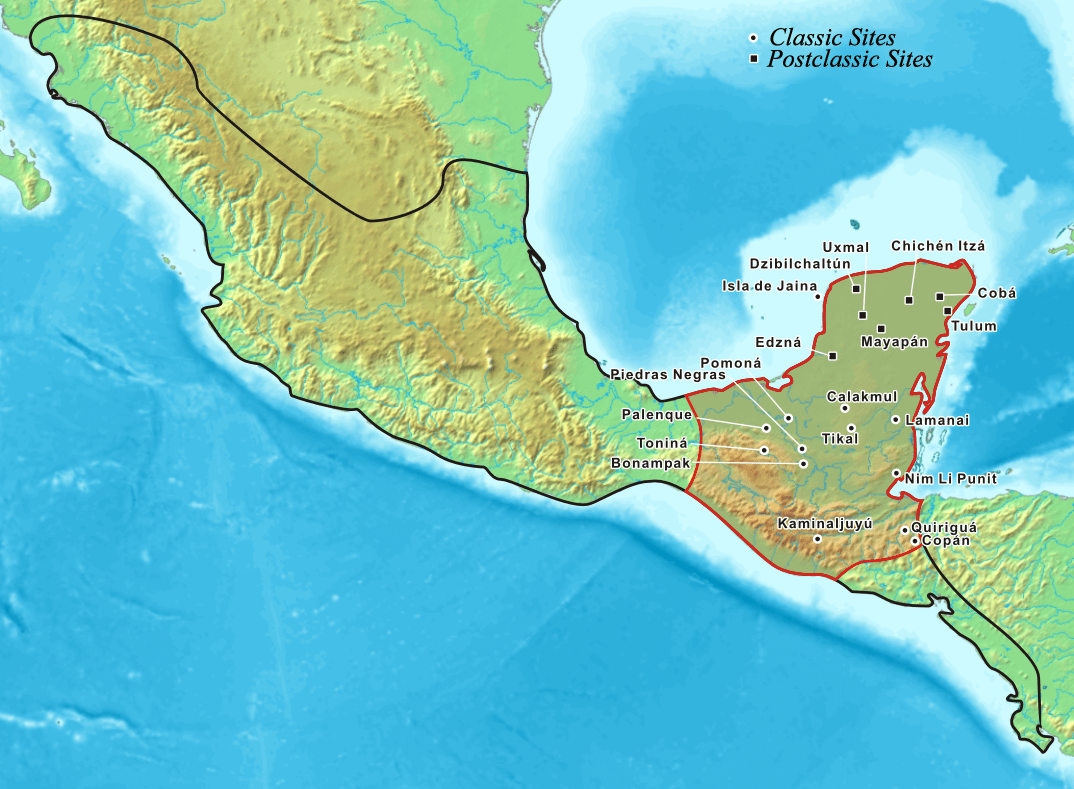
The extent of the Mayan empire

The Mayan Calendar
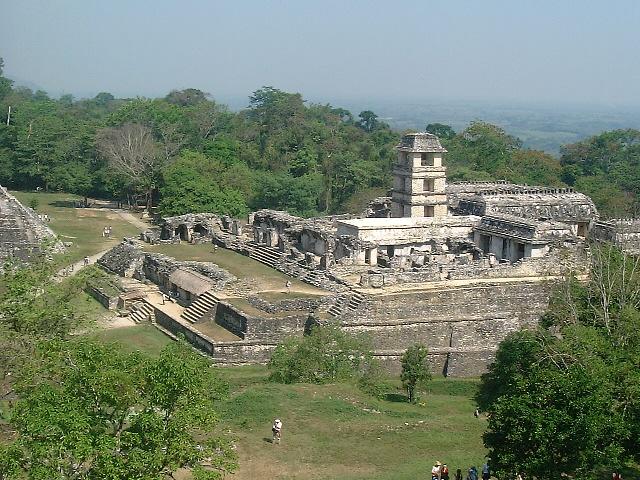
So what is the Mayan Calendar? The calendar was constructed by an advanced civilization called the Mayans around 250-900 AD. Evidence for the Maya empire stretches around most parts of the southern states of Mexico and reaches down to the current geological locations of Guatemala, Belize, El Salvador and some of Honduras. The people living in Mayan society exhibited very advanced written skills and had an amazing ability when constructing cities and urban planning. The Mayans are probably most famous for their pyramids and other intricate and grand buildings. The people of Maya had a huge impact on Central American culture, not just within their civilization, but with other indigenous populations in the region. Significant numbers of Mayans still live today, continuing their age-old traditions.

The Mayans used many different calendars and viewed time as a meshing of spiritual cycles. While the calendars had practical uses, such as social, agricultural, commercial and administrative tasks, there was a very heavy religious element. Each day had a patron spirit, signifying that each day had specific use. This contrasts greatly with our modern Gregorian calendar which primarily sets the administrative, social and economic dates.

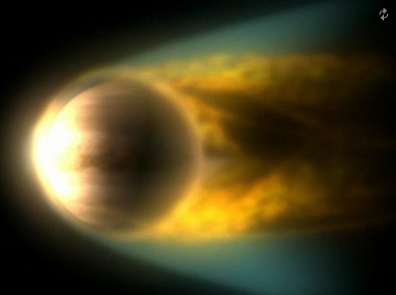
Venus Express observation of Venus (ESA)

Most of the Mayan calendars were short. The Tzolk'in calendar lasted for 260 days and the Haab' approximated the solar year of 365 days. The Mayans then combined both the Tzolk'in and the Haab' to form the "Calendar Round", a cycle lasting 52 Haab's (around 52 years, or the approximate length of a generation). Within the Calendar Round were the trecena (13 day cycle) and the veintena (20 day cycle). Obviously, this system would only be of use when considering the 18,980 unique days over the course of 52 years. In addition to these systems, the Mayans also had the "Venus Cycle". Being keen and highly accurate astronomers they formed a calendar based on the location of Venus in the night sky. It's also possible they did the same with the other planets in the Solar System.

Using the Calendar Round is great if you simply wanted to remember the date of your birthday or significant religious periods, but what about recording history? There was no way to record a date older than 52 years.

The end of the Long Count = the end of the Earth?
The Mayans had a solution. Using an innovative method, they were able to expand on the 52 year Calendar Round. Up to this point, the Mayan Calendar may have sounded a little archaic - after all, it was possibly based on religious belief, the menstrual cycle, mathematical calculations using the numbers 13 and 20 as the base units and a heavy mix of astrological myth. The only principal correlation with the modern calendar is the Haab' that recognised there were 365 days in one solar year (it's not clear whether the Mayans accounted for leap years). The answer to a longer calendar could be found in the "Long Count", a calendar lasting 5126 years.

I'm personally very impressed with this dating system. For starters, it is numerically predictable and it can accurately pinpoint historical dates. However, it depends on a base unit of 20 (where modern calendars use a base unit of 10). So how does this work?

The base year for the Mayan Long Count starts at "0.0.0.0.0". Each zero goes from 0-19 and each represent a tally of Mayan days. So, for example, the first day in the Long Count is denoted as 0.0.0.0.1. On the 19th day we'll have 0.0.0.0.19, on the 20th day it goes up one level and we'll have 0.0.0.1.0. This count continues until 0.0.1.0.0 (about one year), 0.1.0.0.0 (about 20 years) and 1.0.0.0.0 (about 400 years). Therefore, if I pick an arbitrary date of 2.10.12.7.1, this represents the Mayan date of approximately 1012 years, 7 months and 1 day.

This is all very interesting, but what has this got to do with the end of the world? The Mayan Prophecy is wholly based on the assumption that something bad is going to happen when the Mayan Long Count calendar runs out. Experts are divided as to when the Long Count ends, but as the Maya used the numbers of 13 and 20 at the root of their numerical systems, the last day could occur on 13.0.0.0.0. When does this happen? Well, 13.0.0.0.0 represents 5126 years and the Long Count started on 0.0.0.0.0, which corresponds to the modern date of August 11th 3114 BC. Have you seen the problem yet? The Mayan Long Count ends 5126 years later on December 21st, 2012.

Doomsday
When something ends (even something as innocent as an ancient calendar), people seem to think up the most extreme possibilities for the end of civilization as we know it. A brief scan of the internet will pull up the most popular to some very weird ways that we will, with little logical thought, be wiped off the face of the planet. Archaeologists and mythologists on the other hand believe that the Mayans predicted an age of enlightenment when 13.0.0.0.0 comes around; there isn't actually much evidence to suggest doomsday will strike. If anything, the Mayans predict a religious miracle, not anything sinister.

Myths are abound and seem to be fuelling movie storylines. It looks like the new Indiana Jones and the Kingdom of the Crystal Skull is even based around the Mayan myth that 13 crystal skulls can save humanity from certain doom. This myth says that if the 13 ancient skulls are not brought together at the right time, the Earth will be knocked off its axis. This might be a great plotline for blockbuster movies, but it also highlights the hype that can be stirred, lighting up religious, scientific and not-so-scientific ideas that the world is doomed.

Could an asteroid wipe out the Earth? (NASA)

Some of the most popular space-based threats to the Earth and mankind focus on meteorite impacts, black holes, Gamma Ray Bursts from nearby galaxies, a rapid ice age and a polar (magnetic) shift. There is so much evidence against these things happening in 2012, it's shocking just how much of a following they have generated. Each of the above "threats" needs their own devoted article as to why there is no hard evidence to support the hype.

But the fact remains, the Mayan Doomsday Prophecy is purely based on a calendar which we believe hasn't been designed to calculate dates beyond 2012. Mayan archaeo-astronomers are even in debate as to whether the Long Count is designed to be reset to 0.0.0.0.0 after 13.0.0.0.0, or whether the calendar simply continues to 20.0.0.0.0 (approximately 8000 AD) and then reset. As Karl Kruszelnicki brilliantly writes:

"…when a calendar comes to the end of a cycle, it just rolls over into the next cycle. In our Western society, every year 31 December is followed, not by the End of the World, but by 1 January. So 13.0.0.0.0 in the Mayan calendar will be followed by 0.0.0.0.1 - or good-ol' 22 December 2012, with only a few shopping days left to Christmas." - Excerpt from Dr Karl's "Great Moments in Science".

So even if the world ends or life as we know it ceases to exist, I doubt it will be as a direct result of the Mayan calendar suddenly coming to an abrupt halt.

Walter

Sources: Dr Karl's Great Moments in Science, IHT, 2012 Wiki

Leading image credits: MIT, WikiMedia. Effects and editing: Tomato Creative Studios.